Single continuous one-take shot, approximately 15 seconds, absolutely no cuts. Photorealistic live-action feature film. No BGM, no music, no score, no soundtrack. Use only realistic diegetic sound: fast footsteps on roof tiles, cloth movement, wind, breathing, four-point metal shuriken spinning through the air, metal-on-metal impacts, sword ringing, armor impacts, roof tiles cracking, distant lantern flames, and natural nighttime ambience. Every frame should look like a premium cinematic film still from a high-budget historical action movie, with meticulous composition, natural color grading, subtle film grain, realistic highlight roll-off, authentic optical imperfections, and a grounded practical stunt feeling. Shot like a live-action samurai thriller, not a fantasy animation. ARRI Alexa 35, 35mm anamorphic lens, natural cinematic motion blur, low-contrast moonlit color palette, realistic shadows, detailed textures, practical lighting, real fabric movement, believable human body weight. Avoid any CGI, anime, manga, cartoon, comic-book, game-render, digital cutscene, or stylized fantasy appearance. (0–4s) A seamless hybrid drone-to-gimbal camera movement flies low and fast alongside a ninja, staying close to his left side as he runs across the moonlit tiled rooftops of a traditional Japanese estate. He is dressed entirely in matte black, wearing a black Hannya mask whose fierce grin briefly catches the cold moonlight. His sword is already drawn in his right hand while he runs. The ninja moves by sprinting, stepping, vaulting, and jumping from roof ridge to roof ridge. He must not slide across the roof. He plants his feet firmly on the roof tiles, pushes off with real leg power, leaps over roof ridges, lands with weight, and immediately continues running. Each step should feel like a trained stunt performer moving quickly across an unstable tiled rooftop. The camera tracks him tightly as he runs over the roof tiles, jumps across gaps, vaults over ridges, and regains balance with realistic body weight. Nobori banners whip violently in the wind, warm paper lanterns glow softly below, and distant rooftops pass behind him in soft cinematic blur. His clothing carries convincing physical weight, reacting naturally to every step, jump, turn, landing, and gust of wind. The movement must feel like a real stunt performer executing dangerous practical rooftop choreography, not sliding, skating, or gliding. (4–7s) The ninja reaches the highest roof ridge. The camera moves behind him, looking over his shoulder toward the front of the rooftop. From the darkness ahead, several four-point metal shuriken suddenly fly directly toward the ninja. The shuriken must be traditional flat four-point throwing stars: compact metal weapons with four short sharp blades around a small center hole. They must never look like knives, daggers, swords, arrows, spears, or long blade-shaped weapons. They spin rapidly through the cold moonlit air, reflecting blue-white moonlight from their scratched steel surfaces. Time slows dramatically. The camera briefly pushes into a tight close-up of the incoming shuriken spinning toward the ninja. Then the camera returns behind the ninja’s shoulder so both the ninja and the incoming shuriken are clearly visible in the same frame. The shuriken are flying straight toward the ninja’s chest, mask, shoulders, and waist. The ninja already has his sword drawn before the shuriken arrive. At the exact moment the shuriken are about to hit him, he jumps upward from the roof tiles. While airborne, he performs one complete 360-degree spinning jump. As his body rotates, the sword rotates with him in a controlled circular motion. The sword is driven by the ninja’s body rotation, and the spinning blade deflects the incoming shuriken one by one. The action must read clearly: the shuriken fly at the ninja first, then the ninja jumps, then he spins one full 360-degree rotation in mid-air, and during that spinning jump, the rotating sword knocks the shuriken away. During the airborne spin, the first shuriken is struck by the sword and ricochets off to the side with a sharp metal clang. The second is knocked upward by the turning blade. The third glances off the sword edge and spins away into the dark. The fourth is deflected just before it reaches his torso. Every deflection happens during the same single spinning jump. The sword must visibly intercept the shuriken; they must not simply miss on their own. The deflected shuriken fly away and embed into roof tiles and wooden beams nearby. The embedded weapons must still clearly appear as flat four-point cross-shaped metal shuriken with a center hole, not knives or long blades. His black robes and sleeves flare outward naturally from the force of the jump and rotation. The fabric must feel heavy and real, reacting to gravity, wind, and rotational momentum. The movement should be fast, elegant, and cinematic, but still physically believable as a difficult practical stunt, not a weightless superhero move. The sword arc should feel precise, efficient, and controlled, like a master swordsman using body rotation to create defensive power. (7–9s) Time instantly returns to normal speed. The ninja lands hard back onto the sloped tiled rooftop in a low fighting stance, sword still in hand. Several roof tiles crack under his landing foot. After landing, he immediately runs forward again across the rooftop, stepping quickly and powerfully over the tiles. He does not slide, skid, skate, or glide. His feet strike the roof tiles with clear weight and traction. The camera stays close and continuous as samurai emerge from both sides of the roof ridge, stepping out from behind wooden beams, tiled slopes, and raised rooftop walkways. They surround him on the rooftop from multiple directions, their armor catching warm lantern light from below and cold moonlight from above. The rooftop is narrow, sloped, wet, unstable, and dangerous. (9–14s) The ninja immediately launches into a fast rooftop close-quarters combat sequence. With sword already drawn, he fights with brutal efficiency and speed. He parries the first katana strike, traps the attacker’s wrist, and counters with a short body turn and elbow. He redirects another attacker’s weapon, shoulder-checks him off balance, and follows with a fast slash across the armor guard area. A third samurai rushes from behind; the ninja pivots, ducks, and uses a tight spinning cut to force him back. A fourth samurai attacks from the side; the ninja steps inside the attack, strikes with the hilt, then sweeps the attacker’s legs and sends him crashing onto the roof tiles. The fight should feel very fast, tight, and dangerous, but always grounded in realistic martial arts and practical stunt choreography. The ninja and samurai must move by running, stepping, jumping, pivoting, and landing on the roof tiles. No sliding across the roof, no skating movement, no gliding over tiles. Every foot placement should show traction, impact, and body weight. The camera moves in a low circular orbit around the rooftop fight, staying close enough to feel intense while keeping the geography clear. Broken tiles scatter, armor plates collide, blades ring, lantern sparks flicker in the wind, and the ninja’s black robes snap with each movement. (14–15s) The final samurai falls out of frame. The ninja stops suddenly on the roof ridge, breathing heavily but controlled, sword lowered but still ready. Several deflected four-point shuriken remain embedded in the cracked roof tiles and beams around him. The camera pushes in quickly toward his black Hannya mask. Moonlight catches the fierce grin of the mask, while his eyes remain visible through the dark openings. End on an intense close-up zoom-in of the Hannya mask, with wind whipping the black fabric around his face. Negative prompt: BGM, music, score, soundtrack, orchestral music, epic trailer music, sliding on roof tiles, roof sliding, skating, gliding, slipping as a movement style, surfing on roof, sliding attack, anime slide, manga slide, cartoon, comic book, cel shading, 2D animation, video game, CGI look, plastic textures, fantasy ninja, superhero movement, magical effects, glowing weapons, exaggerated poses, unrealistic acrobatics, stylized speed lines, over-choreographed wire-fu, weightless movement, low-detail costume, clean digital render, game cutscene, artificial lighting, overly saturated colors, smooth plastic skin, fake armor, toy-like weapons, digital particles, fantasy aura, excessive slow motion, impossible physics, knife-shaped shuriken, dagger-shaped shuriken, sword-shaped shuriken, arrow-shaped shuriken, spear-shaped shuriken, long blade-shaped shuriken, single-blade projectile, shuriken turning into knives, shuriken turning into swords, shuriken simply missing without being deflected, sword appearing only after the shuriken arrive, unclear action, unreadable combat geography
Single continuous one-take shot, approximately 15 seconds, absolutely no cuts. Photorealistic live-action feature film.
No BGM, no music, no score, no soundtrack. Use only realistic diegetic sound: fast footsteps on roof tiles, cloth movement, wind, breathing, four-point metal shuriken spinning through the air, metal-on-metal impacts, sword ringing, armor impacts, roof tiles cracking, distant lantern flames, and natural nighttime ambience.
Every frame should look like a premium cinematic film still from a high-budget historical action movie, with meticulous composition, natural color grading, subtle film grain, realistic highlight roll-off, authentic optical imperfections, and a grounded practical stunt feeling.
Shot like a live-action samurai thriller, not a fantasy animation. ARRI Alexa 35, 35mm anamorphic lens, natural cinematic motion blur, low-contrast moonlit color palette, realistic shadows, detailed textures, practical lighting, real fabric movement, believable human body weight.
Avoid any CGI, anime, manga, cartoon, comic-book, game-render, digital cutscene, or stylized fantasy appearance.
(0–4s)
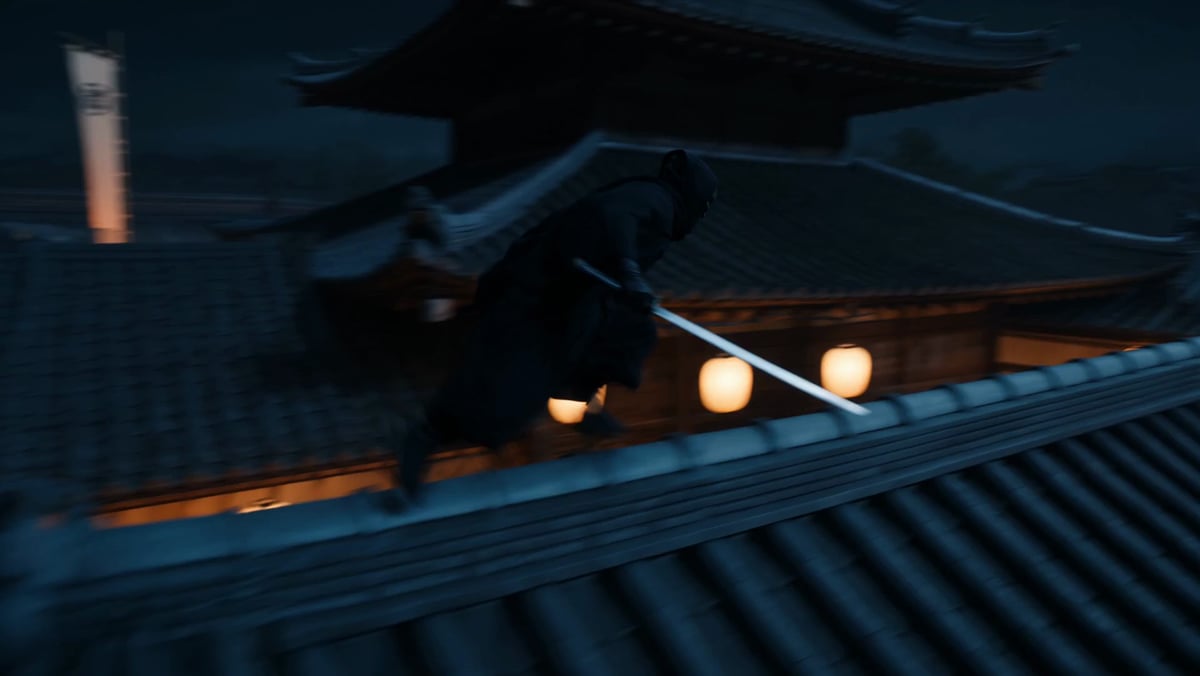
A seamless hybrid drone-to-gimbal camera movement flies low and fast alongside a ninja, staying close to his left side as he runs across the moonlit tiled rooftops of a traditional Japanese estate.
He is dressed entirely in matte black, wearing a black Hannya mask whose fierce grin briefly catches the cold moonlight.
His sword is already drawn in his right hand while he runs.
The ninja moves by sprinting, stepping, vaulting, and jumping from roof ridge to roof ridge.
He must not slide across the roof.
He plants his feet firmly on the roof tiles, pushes off with real leg power, leaps over roof ridges, lands with weight, and immediately continues running.
Each step should feel like a trained stunt performer moving quickly across an unstable tiled rooftop.
The camera tracks him tightly as he runs over the roof tiles, jumps across gaps, vaults over ridges, and regains balance with realistic body weight.
Nobori banners whip violently in the wind, warm paper lanterns glow softly below, and distant rooftops pass behind him in soft cinematic blur.
His clothing carries convincing physical weight, reacting naturally to every step, jump, turn, landing, and gust of wind.
The movement must feel like a real stunt performer executing dangerous practical rooftop choreography, not sliding, skating, or gliding.
(4–7s)
The ninja reaches the highest roof ridge.
The camera moves behind him, looking over his shoulder toward the front of the rooftop.
From the darkness ahead, several four-point metal shuriken suddenly fly directly toward the ninja.
The shuriken must be traditional flat four-point throwing stars: compact metal weapons with four short sharp blades around a small center hole.
They must never look like knives, daggers, swords, arrows, spears, or long blade-shaped weapons.
They spin rapidly through the cold moonlit air, reflecting blue-white moonlight from their scratched steel surfaces.
Time slows dramatically.
The camera briefly pushes into a tight close-up of the incoming shuriken spinning toward the ninja.
Then the camera returns behind the ninja’s shoulder so both the ninja and the incoming shuriken are clearly visible in the same frame.
The shuriken are flying straight toward the ninja’s chest, mask, shoulders, and waist.
The ninja already has his sword drawn before the shuriken arrive.
At the exact moment the shuriken are about to hit him, he jumps upward from the roof tiles.
While airborne, he performs one complete 360-degree spinning jump.
As his body rotates, the sword rotates with him in a controlled circular motion.
The sword is driven by the ninja’s body rotation, and the spinning blade deflects the incoming shuriken one by one.
The action must read clearly:
the shuriken fly at the ninja first,
then the ninja jumps,
then he spins one full 360-degree rotation in mid-air,
and during that spinning jump, the rotating sword knocks the shuriken away.
During the airborne spin, the first shuriken is struck by the sword and ricochets off to the side with a sharp metal clang.
The second is knocked upward by the turning blade.
The third glances off the sword edge and spins away into the dark.
The fourth is deflected just before it reaches his torso.
Every deflection happens during the same single spinning jump.
The sword must visibly intercept the shuriken; they must not simply miss on their own.
The deflected shuriken fly away and embed into roof tiles and wooden beams nearby.
The embedded weapons must still clearly appear as flat four-point cross-shaped metal shuriken with a center hole, not knives or long blades.
His black robes and sleeves flare outward naturally from the force of the jump and rotation.
The fabric must feel heavy and real, reacting to gravity, wind, and rotational momentum.
The movement should be fast, elegant, and cinematic, but still physically believable as a difficult practical stunt, not a weightless superhero move.
The sword arc should feel precise, efficient, and controlled, like a master swordsman using body rotation to create defensive power.
(7–9s)
Time instantly returns to normal speed.
The ninja lands hard back onto the sloped tiled rooftop in a low fighting stance, sword still in hand.
Several roof tiles crack under his landing foot.
After landing, he immediately runs forward again across the rooftop, stepping quickly and powerfully over the tiles.
He does not slide, skid, skate, or glide.
His feet strike the roof tiles with clear weight and traction.
The camera stays close and continuous as samurai emerge from both sides of the roof ridge, stepping out from behind wooden beams, tiled slopes, and raised rooftop walkways.
They surround him on the rooftop from multiple directions, their armor catching warm lantern light from below and cold moonlight from above.
The rooftop is narrow, sloped, wet, unstable, and dangerous.
(9–14s)
The ninja immediately launches into a fast rooftop close-quarters combat sequence.
With sword already drawn, he fights with brutal efficiency and speed.
He parries the first katana strike, traps the attacker’s wrist, and counters with a short body turn and elbow.
He redirects another attacker’s weapon, shoulder-checks him off balance, and follows with a fast slash across the armor guard area.
A third samurai rushes from behind; the ninja pivots, ducks, and uses a tight spinning cut to force him back.
A fourth samurai attacks from the side; the ninja steps inside the attack, strikes with the hilt, then sweeps the attacker’s legs and sends him crashing onto the roof tiles.
The fight should feel very fast, tight, and dangerous, but always grounded in realistic martial arts and practical stunt choreography.
The ninja and samurai must move by running, stepping, jumping, pivoting, and landing on the roof tiles.
No sliding across the roof, no skating movement, no gliding over tiles.
Every foot placement should show traction, impact, and body weight.
The camera moves in a low circular orbit around the rooftop fight, staying close enough to feel intense while keeping the geography clear.
Broken tiles scatter, armor plates collide, blades ring, lantern sparks flicker in the wind, and the ninja’s black robes snap with each movement.
(14–15s)
The final samurai falls out of frame.
The ninja stops suddenly on the roof ridge, breathing heavily but controlled, sword lowered but still ready.
Several deflected four-point shuriken remain embedded in the cracked roof tiles and beams around him.
The camera pushes in quickly toward his black Hannya mask.
Moonlight catches the fierce grin of the mask, while his eyes remain visible through the dark openings.
End on an intense close-up zoom-in of the Hannya mask, with wind whipping the black fabric around his face.
Negative prompt:
BGM, music, score, soundtrack, orchestral music, epic trailer music, sliding on roof tiles, roof sliding, skating, gliding, slipping as a movement style, surfing on roof, sliding attack, anime slide, manga slide, cartoon, comic book, cel shading, 2D animation, video game, CGI look, plastic textures, fantasy ninja, superhero movement, magical effects, glowing weapons, exaggerated poses, unrealistic acrobatics, stylized speed lines, over-choreographed wire-fu, weightless movement, low-detail costume, clean digital render, game cutscene, artificial lighting, overly saturated colors, smooth plastic skin, fake armor, toy-like weapons, digital particles, fantasy aura, excessive slow motion, impossible physics, knife-shaped shuriken, dagger-shaped shuriken, sword-shaped shuriken, arrow-shaped shuriken, spear-shaped shuriken, long blade-shaped shuriken, single-blade projectile, shuriken turning into knives, shuriken turning into swords, shuriken simply missing without being deflected, sword appearing only after the shuriken arrive, unclear action, unreadable combat geography
Single continuous one-take shot, approximately 15 seconds, absolutely no cuts. Photorealistic live-action feature film. No BGM, no music, no score, no soundtrack. Use only realistic diegetic sound: fast footsteps on roof tiles, cloth movement, wind, breathing, four-point metal shuriken spinning through the air, metal-on-metal impacts, sword ringing, armor impacts, roof tiles cracking, distant lantern flames, and natural nighttime ambience. Every frame should look like a premium cinematic film still from a high-budget historical action movie, with meticulous composition, natural color grading, subtle film grain, realistic highlight roll-off, authentic optical imperfections, and a grounded practical stunt feeling. Shot like a live-action samurai thriller, not a fantasy animation. ARRI Alexa 35, 35mm anamorphic lens, natural cinematic motion blur, low-contrast moonlit color palette, realistic shadows, detailed textures, practical lighting, real fabric movement, believable human body weight. Avoid any CGI, anime, manga, cartoon, comic-book, game-render, digital cutscene, or stylized fantasy appearance. (0–4s) A seamless hybrid drone-to-gimbal camera movement flies low and fast alongside a ninja, staying close to his left side as he runs across the moonlit tiled rooftops of a traditional Japanese estate. He is dressed entirely in matte black, wearing a black Hannya mask whose fierce grin briefly catches the cold moonlight. His sword is already drawn in his right hand while he runs. The ninja moves by sprinting, stepping, vaulting, and jumping from roof ridge to roof ridge. He must not slide across the roof. He plants his feet firmly on the roof tiles, pushes off with real leg power, leaps over roof ridges, lands with weight, and immediately continues running. Each step should feel like a trained stunt performer moving quickly across an unstable tiled rooftop. The camera tracks him tightly as he runs over the roof tiles, jumps across gaps, vaults over ridges, and regains balance with realistic body weight. Nobori banners whip violently in the wind, warm paper lanterns glow softly below, and distant rooftops pass behind him in soft cinematic blur. His clothing carries convincing physical weight, reacting naturally to every step, jump, turn, landing, and gust of wind. The movement must feel like a real stunt performer executing dangerous practical rooftop choreography, not sliding, skating, or gliding. (4–7s) The ninja reaches the highest roof ridge. The camera moves behind him, looking over his shoulder toward the front of the rooftop. From the darkness ahead, several four-point metal shuriken suddenly fly directly toward the ninja. The shuriken must be traditional flat four-point throwing stars: compact metal weapons with four short sharp blades around a small center hole. They must never look like knives, daggers, swords, arrows, spears, or long blade-shaped weapons. They spin rapidly through the cold moonlit air, reflecting blue-white moonlight from their scratched steel surfaces. Time slows dramatically. The camera briefly pushes into a tight close-up of the incoming shuriken spinning toward the ninja. Then the camera returns behind the ninja’s shoulder so both the ninja and the incoming shuriken are clearly visible in the same frame. The shuriken are flying straight toward the ninja’s chest, mask, shoulders, and waist. The ninja already has his sword drawn before the shuriken arrive. At the exact moment the shuriken are about to hit him, he jumps upward from the roof tiles. While airborne, he performs one complete 360-degree spinning jump. As his body rotates, the sword rotates with him in a controlled circular motion. The sword is driven by the ninja’s body rotation, and the spinning blade deflects the incoming shuriken one by one. The action must read clearly: the shuriken fly at the ninja first, then the ninja jumps, then he spins one full 360-degree rotation in mid-air, and during that spinning jump, the rotating sword knocks the shuriken away. During the airborne spin, the first shuriken is struck by the sword and ricochets off to the side with a sharp metal clang. The second is knocked upward by the turning blade. The third glances off the sword edge and spins away into the dark. The fourth is deflected just before it reaches his torso. Every deflection happens during the same single spinning jump. The sword must visibly intercept the shuriken; they must not simply miss on their own. The deflected shuriken fly away and embed into roof tiles and wooden beams nearby. The embedded weapons must still clearly appear as flat four-point cross-shaped metal shuriken with a center hole, not knives or long blades. His black robes and sleeves flare outward naturally from the force of the jump and rotation. The fabric must feel heavy and real, reacting to gravity, wind, and rotational momentum. The movement should be fast, elegant, and cinematic, but still physically believable as a difficult practical stunt, not a weightless superhero move. The sword arc should feel precise, efficient, and controlled, like a master swordsman using body rotation to create defensive power. (7–9s) Time instantly returns to normal speed. The ninja lands hard back onto the sloped tiled rooftop in a low fighting stance, sword still in hand. Several roof tiles crack under his landing foot. After landing, he immediately runs forward again across the rooftop, stepping quickly and powerfully over the tiles. He does not slide, skid, skate, or glide. His feet strike the roof tiles with clear weight and traction. The camera stays close and continuous as samurai emerge from both sides of the roof ridge, stepping out from behind wooden beams, tiled slopes, and raised rooftop walkways. They surround him on the rooftop from multiple directions, their armor catching warm lantern light from below and cold moonlight from above. The rooftop is narrow, sloped, wet, unstable, and dangerous. (9–14s) The ninja immediately launches into a fast rooftop close-quarters combat sequence. With sword already drawn, he fights with brutal efficiency and speed. He parries the first katana strike, traps the attacker’s wrist, and counters with a short body turn and elbow. He redirects another attacker’s weapon, shoulder-checks him off balance, and follows with a fast slash across the armor guard area. A third samurai rushes from behind; the ninja pivots, ducks, and uses a tight spinning cut to force him back. A fourth samurai attacks from the side; the ninja steps inside the attack, strikes with the hilt, then sweeps the attacker’s legs and sends him crashing onto the roof tiles. The fight should feel very fast, tight, and dangerous, but always grounded in realistic martial arts and practical stunt choreography. The ninja and samurai must move by running, stepping, jumping, pivoting, and landing on the roof tiles. No sliding across the roof, no skating movement, no gliding over tiles. Every foot placement should show traction, impact, and body weight. The camera moves in a low circular orbit around the rooftop fight, staying close enough to feel intense while keeping the geography clear. Broken tiles scatter, armor plates collide, blades ring, lantern sparks flicker in the wind, and the ninja’s black robes snap with each movement. (14–15s) The final samurai falls out of frame. The ninja stops suddenly on the roof ridge, breathing heavily but controlled, sword lowered but still ready. Several deflected four-point shuriken remain embedded in the cracked roof tiles and beams around him. The camera pushes in quickly toward his black Hannya mask. Moonlight catches the fierce grin of the mask, while his eyes remain visible through the dark openings. End on an intense close-up zoom-in of the Hannya mask, with wind whipping the black fabric around his face. Negative prompt: BGM, music, score, soundtrack, orchestral music, epic trailer music, sliding on roof tiles, roof sliding, skating, gliding, slipping as a movement style, surfing on roof, sliding attack, anime slide, manga slide, cartoon, comic book, cel shading, 2D animation, video game, CGI look, plastic textures, fantasy ninja, superhero movement, magical effects, glowing weapons, exaggerated poses, unrealistic acrobatics, stylized speed lines, over-choreographed wire-fu, weightless movement, low-detail costume, clean digital render, game cutscene, artificial lighting, overly saturated colors, smooth plastic skin, fake armor, toy-like weapons, digital particles, fantasy aura, excessive slow motion, impossible physics, knife-shaped shuriken, dagger-shaped shuriken, sword-shaped shuriken, arrow-shaped shuriken, spear-shaped shuriken, long blade-shaped shuriken, single-blade projectile, shuriken turning into knives, shuriken turning into swords, shuriken simply missing without being deflected, sword appearing only after the shuriken arrive, unclear action, unreadable combat geography
Glitchbloom
Vigloo Studio에서 생성